How to find a rental home in Amsterdam in 2026
Amsterdam is the most expensive rental city in the Netherlands, and the competition is fierce. But finding a home isn’t pure luck. Here’s a practical strategy that works in 2026.
Finding a rental home in Amsterdam can feel like a lottery you keep losing. You refresh the same sites, send messages, and hear nothing back. But it isn’t pure luck. The people who find a place usually do a few things differently: they know the numbers, they search wider, and they’re ready before the listing goes online.
This guide gives you a practical strategy for 2026, based on how the market actually works right now.
The Amsterdam rental market in 2026: the numbers
Amsterdam is the most expensive rental city in the Netherlands. According to NVM and VGM NL, free-sector rents in Amsterdam averaged €25.70 per m² per month in the second quarter of 2026, the highest in the country. Nationally, the average was €19.32 per m², up 9.4% on a year earlier.
There’s cautious good news too: around 650 free-sector homes were rented in Amsterdam that quarter, over 20% more than a year earlier. But across the country, the number of rentals is still roughly half the level of 2015 to 2022, and good homes regularly get hundreds of responses.
What that means in practice: a 50 m² apartment at the Amsterdam average costs about €1,285 per month, and you’re competing with many others for each one.
In short: supply is slowly growing, but demand is still far higher. You win on preparation and speed, not on luck.
Step 1: know your budget and the income requirement
Most landlords ask for a gross monthly income of around three to four times the rent. Work backwards from your income to a realistic maximum rent, and then to a realistic size using the price per m². It saves you from responding to homes you’ll be rejected for anyway.
Also check which part of the market you belong in. Since the Affordable Rent Act (Wet betaalbare huur), part of the mid-rent segment has a regulated maximum rent based on a points system. If a home seems expensive for its size and quality, you can have the rent checked through the Rent Tribunal (Huurcommissie).
Step 2: search wider than you think
Neighbourhoods
Many people only search within the ring road. Areas such as Amsterdam-Noord, Nieuw-West and Zuidoost often have more supply and are well connected by metro, ferry or bike. Being flexible on the neighbourhood is one of the biggest levers you have.
Nearby cities
Amstelveen, Diemen, Zaandam, Haarlem, Almere and Hoofddorp are all within easy reach of Amsterdam. Adding one or two of them to your search can multiply the number of homes you see.
Sources
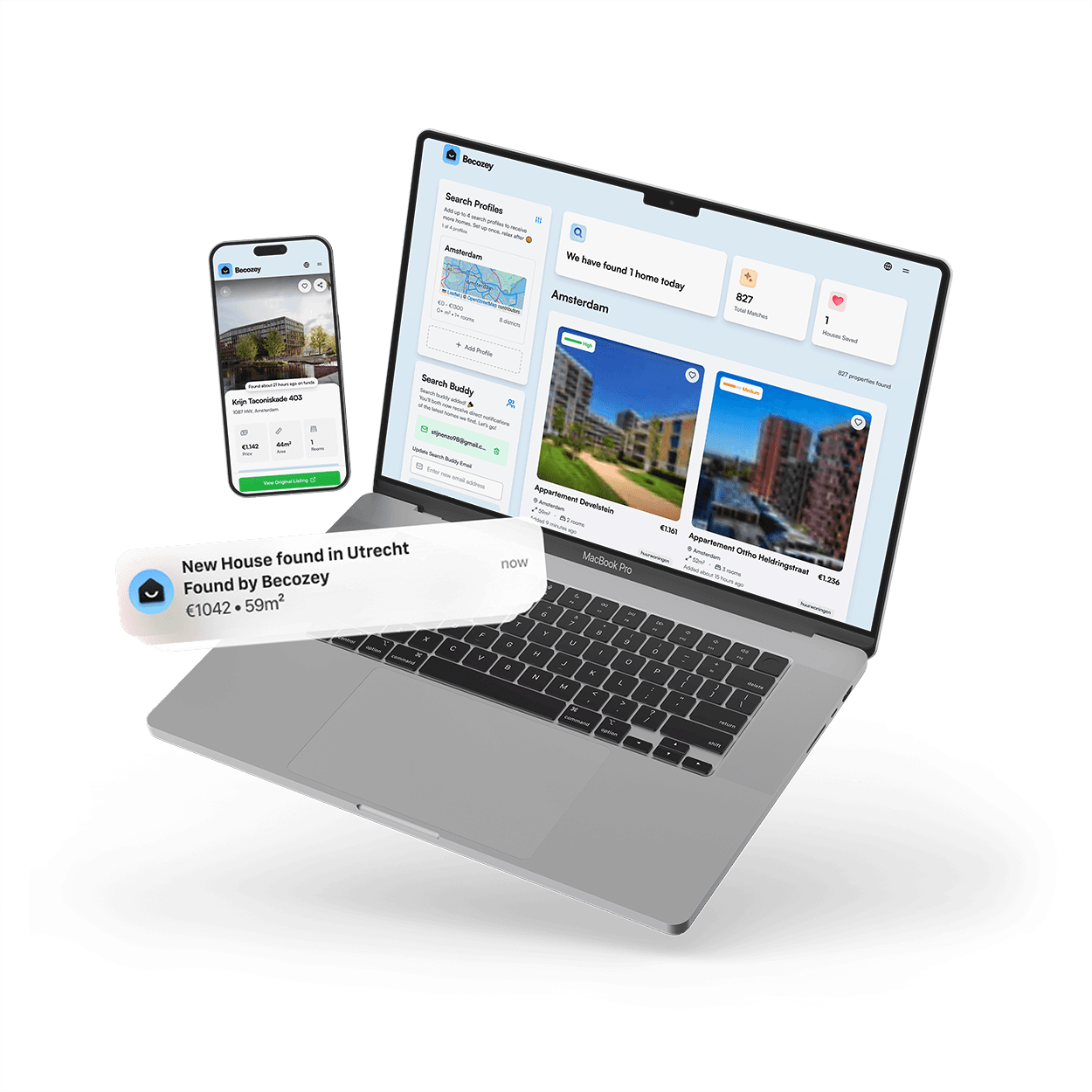
Listings are spread across the big platforms, hundreds of letting agent websites, institutional investors and housing corporations. Many homes appear on a smaller agent’s site first, sometimes hours before they reach the big platforms. That’s exactly where an alert service like Becozey helps: it scans 1,000+ Dutch rental websites and notifies you as soon as a home matches your search.
Step 3: register for social housing anyway
If your income allows it, register with WoningNet for social housing in the Amsterdam region today. Waiting times are long, often many years, but registration time counts. Even if you find something in the free sector now, it’s an option that grows in value for later.
Step 4: be ready before the listing goes online
- Your documents in one folder: ID (shared via KopieID), recent payslips, employer’s statement, landlord reference
- A short motivation letter you can adapt in a minute (see how to write a rental motivation letter)
- Alerts turned on for your search, so you hear about new homes within minutes
- Time blocked to view quickly, even on short notice
- A clear idea of your must-haves and nice-to-haves
The reason this matters: many agents stop scheduling viewings after the first group of responses. Responding within the first hour is often the difference between a viewing and silence.
Step 5: at the viewing, show you’re the easy choice
Arrive on time, ask good questions, and say clearly that your documents are ready and when you can move in. Send a short follow-up message the same day. If there’s room, you can sometimes negotiate on terms rather than price; read how to negotiate rent for what works.
Watch out for scams and illegal clauses
Pressure on the market attracts scammers. Never pay before you’ve viewed the home and signed a contract, and be wary of prices that are too good for the location. The deposit may be at most two months’ basic rent, and if an agent works for the landlord, you don’t pay agency fees. Read how to spot a rental scam for the full checklist.
One more thing for newcomers: if you’re staying longer than four months, you must register your address with the municipality (BRP). Make sure the landlord allows registration at the address before you sign. Without it, you can run into trouble with things like your BSN, healthcare insurance and benefits.
Frequently asked questions
How long does it take to find a rental in Amsterdam?
It varies a lot by budget and flexibility. People who search in several neighbourhoods or nearby cities, respond quickly and have their documents ready usually find something much faster than people who wait for the perfect place in one area.
What is the average rent in Amsterdam in 2026?
In the second quarter of 2026, free-sector rents in Amsterdam averaged €25.70 per m² per month, according to NVM and VGM NL. For a 50 m² apartment, that’s about €1,285 per month.
How much do I need to earn to rent in Amsterdam?
Many landlords ask for a gross monthly income of around three to four times the rent. For a rent of €1,300, that means roughly €3,900 to €5,200 gross per month. The exact requirement is usually in the listing.
Which areas near Amsterdam are good alternatives?
Amsterdam-Noord, Nieuw-West and Zuidoost within the city, and nearby places such as Amstelveen, Diemen, Zaandam, Haarlem, Almere and Hoofddorp. They’re well connected and often have more homes available.
Can I register at my address if I rent in Amsterdam?
You should be able to, and if you stay longer than four months, registering with the municipality (BRP) is required. Check with the landlord before signing that registration at the address is allowed.
Where can I find rental homes that aren’t on the big websites?
On the websites of individual letting agents, institutional investors and housing corporations. Because there are so many, an alert service that scans them all, such as Becozey, saves a lot of time.